Transforming San Antonio: An Insider's View to the AT&T Arena, Toyota, the PGA Village, and the Riverwalk Extension by Nelson W. Wolff & Henry Cisneros
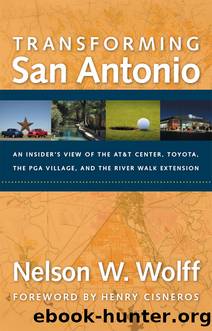
Author:Nelson W. Wolff & Henry Cisneros [Wolff, Nelson W. & Cisneros, Henry]
Language: eng
Format: epub
ISBN: 9781595340467
Goodreads: 3103318
Publisher: Trinity University Press
Published: 2008-04-28T00:00:00+00:00
FOUR
The San Antonio River Walk Extension
ON A BEAUTIFUL SPRING DAY in May 2007, after Lou Agnese, president of the University of the Incarnate Word, and I had lunch in the historic Victorian Brackenridge Villa, we walked some 100 yards toward the northwest area of the campus. Under several large trees, we came upon an artesian well, known as the Blue Hole. Bubbling out of the well was crystal clear water that flowed to the campus footbridge, where Olmos Creek and spring water come together to form the San Antonio River. The river flows south 180 miles to join the Guadalupe River and then washes into the Gulf of Mexico.
As we looked at the Blue Hole, I told Agnese about the beautiful springs I saw bubbling out of the grounds on the northern edge of UIW during the flood of 1998. Among several oaks and palm trees, I watched a magical display of natural sprinklers spewing clear water from the Edwards Aquifer, a porous karst limestone formation stretching 185 miles across six counties. âThat happens only on rare occasions,â Agnese said, âbut the water from our Blue Hole runs continuously except during times of severe drought.â
The river also receives water from Leon, Cibolo, Olmos, and Salado creeks, as well as more than 100 underground springs. San Pedro Creek provides additional water when it merges with the river in south San Antonio at Concepción Park.
When people visit San Antonio, they see only the River Walk, the downtown section of the river lined with restaurants, hotels, and retail stores. Ever since HemisFair in 1968, the River Walk has grown in density and popularity, and significant public improvements have been made. Unfortunately the rest of the river has been neglected and abused until now. As this book goes to press, we are in the early stages of a $200 million, thirteen-mile San Antonio River Walk extension linking the headwaters north of downtown to Mission Espada south of the city. This project is perhaps the most important local public works project of our time.
The river drew Spanish explorers and then settlers to this area centuries ago. On June 13, 1691, Franciscan Father Damian Massanet came upon the Payaya Indian village of Yanaguana, located on the banks of a narrow, meandering river. He named it the San Antonio River in honor of San Antonio de Padua. Nearly twenty-seven years later, on April 25, 1718, MartÃn de Alarcón arrived with seventy-two Spanish settlers and soldiers, setting up a small community and a presidio, or fort, near San Pedro Springs. One month later Father Antonio Olivares arrived to establish Mission San Antonio de Valero, now called the Alamo, nearby. In 1722 the presidio was moved south to the northern edge of what became Military Plaza, where City Hall is today. In 1724 the Alamo ended up a distance of âtwo gunshotsâ east of Military Plaza, above the far bank of the San Antonio River. Following the river south, Father Antonio Margil de Jesús founded Mission San José in 1720.
Download
This site does not store any files on its server. We only index and link to content provided by other sites. Please contact the content providers to delete copyright contents if any and email us, we'll remove relevant links or contents immediately.
The Secret History by Donna Tartt(19088)
The Social Justice Warrior Handbook by Lisa De Pasquale(12190)
Thirteen Reasons Why by Jay Asher(8910)
This Is How You Lose Her by Junot Diaz(6887)
Weapons of Math Destruction by Cathy O'Neil(6280)
Zero to One by Peter Thiel(5802)
Beartown by Fredrik Backman(5754)
The Myth of the Strong Leader by Archie Brown(5507)
The Fire Next Time by James Baldwin(5446)
How Democracies Die by Steven Levitsky & Daniel Ziblatt(5219)
Promise Me, Dad by Joe Biden(5153)
Stone's Rules by Roger Stone(5088)
A Higher Loyalty: Truth, Lies, and Leadership by James Comey(4964)
100 Deadly Skills by Clint Emerson(4925)
Rise and Kill First by Ronen Bergman(4789)
Secrecy World by Jake Bernstein(4753)
The David Icke Guide to the Global Conspiracy (and how to end it) by David Icke(4720)
The Farm by Tom Rob Smith(4513)
The Doomsday Machine by Daniel Ellsberg(4490)
